
Download the Annual Report in English | Hebrew
Zochrot [Remembering] is an Israeli NGO working since 2002 to raise awareness of the Nakba, the Palestinian catastrophe of 1948. The Nakba is an unspoken taboo in Israeli discourse, its memory expunged from the official history of the country and from its physical landscape. Yet the Nakba is also the central trauma of the Israeli-Palestinian conflict, and its legacy continues to unfold today - in the institutionalization of inequality and violence, in the erasure of the past, and in the deteriorating plight of the Palestinian refugees. We hope that by talking about the Nakba in Hebrew, the language spoken by the Jewish majority in Israel, we can engage the public in learning about and taking responsibility for the Nakba and its enduring consequences. A just and workable resolution to the conflict must be founded on this acknowledgment and on the pursuit of equality for all peoples of the region, including the right of the refugees to return.
Zochrot’s activities continued to develop and expand in 2007 with a number of additional projects: the first issue of Sedek appeared, published by Zochrot; the opening of an art gallery in Zochrot’s offices; the publication of a map of Tel Aviv showing the location of destroyed Palestinian villages that had stood on land now included within the city’s boundaries; and work on a educational kit for teaching about the Nakba in schools.
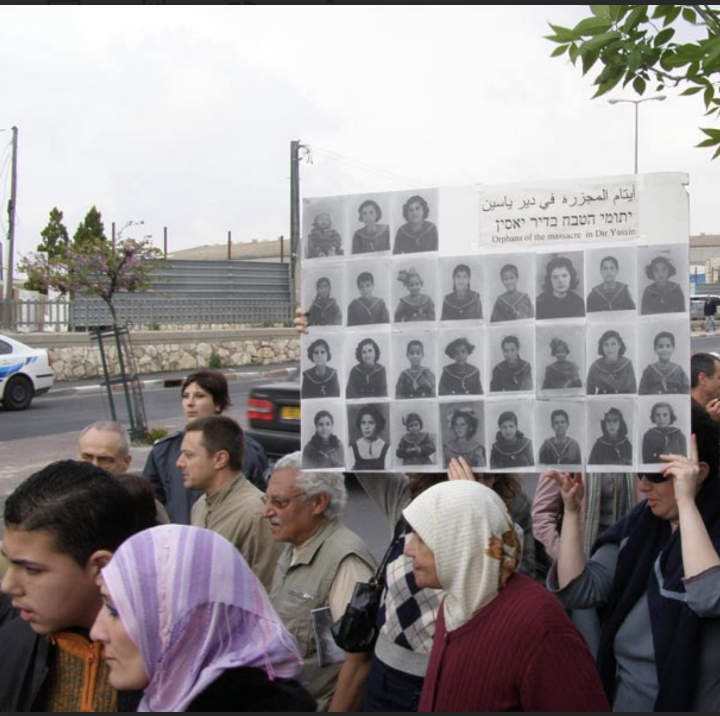
Zochrot conducts field tours to Palestinian sites destroyed in the 1948 Nakba, and to those which have survived. The purpose of these tours trips is to know these sites directly, hear the stories they have to tell, and meet refugees from these locations. These tours also motivate research into their history. On these tours special booklets are published, in Hebrew and in Arabic, present the stories of these places. The field tours include full day tours aimed at the general public, as well as by invitation tours for groups from Israel and from abroad.
In 2007 there were seven full day tours open to the public – to Ramlah, Kafrayn, Hittin, Miska, the Latrun villages (focusing on ‘Imwas), Ajami (in Jaffa) and al-Maliha – although only six were originally planned. A total of about 750 people participated in them, Jews and Arabs. Five booklets were published for the tours to Kafrayn, Hittin, the Latrun villages, Ajami and Al Maliha. For the Ramlah tour we also printed T-shirts criticizing the mayor’s racist remarks about the city’s Arab residents. The largest field tour was to the village of Miska, on Israel’s Independence Day. Participants then joined the March of the Return, organized by the Association for the Defense of the Rights of Internally Displaced Palestinians, held this year in a-Lajjun. The tour to Hittin was a continuation of our opposition to the construction plans threatening to further reduce the village area in order to expand the size of the Jethro Tomb compound.