

We’re on the map
A public activity
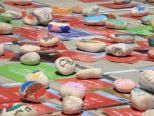
Create a large map of the Palestinian villages destroyed by Israel – a prominent visual representation of the nakba on a map of Israel today. The activity can be carried out in a public square or courtyard, preferably in a visible, central location. Participants receive cards with the names of Palestinian villages and place them in their former locations to recreate the map of Israel that no longer exists. The activity can include additional commemorative acts as well as discussion of the nakba with participants and passers-by.
For detailed instructions, a list of materials and examples
Nakba testimonies and discussion
Films available:
Remembering Jaffa’s Manshiyya neighborhood
Palestinian women tell their stories
The testimony of Amnon Neumann, a Palmach fighter in 1948
Additional films are available on Zochrot’s videos.
Explain what the Nakba is before showing the films. They should be followed by a discussion. Here are some questions that might be asked:
- Why are testimonies about the nakba important?
- How do the testimonies differ from one another?
- What’s the significance of on-site testimony (such as that of Abu Sa’id in Manshiyya) and of public testimony (like that of Amnon Neumann during the public hearing Zochrot organized)?
Discussion of the Nakba Law
A showing of the video, “The Nakba Law – In German it sounds wors" and discussion.
During the May, 2011, Independence Day celebrations, Zochrot protested the Nakba Law passed by the Knesset two months earlier, whose purpose was to prevent inquiry into and learning about the Nakba in Israel. This anti-democratic law is unprecedented in the obligation it imposes on citizens of the state to “not remember.”
We suggest introducing the activity, explaining the Nakba Law and describing the other anti-democratic and racist legislation that has recently been passed by the Knesset. Then show the video that documents Zochrot's protest the Nakba Law (filmed and edited by Lia Tarshansky). Follow the screening with a discussion of these questions:
- What do you think about this protest?
- How would you have reacted if you had seen Zochrot’s protest in Tel Aviv?
- How is this protest related to Israeli collective memory of the Nakba and the holocaust?
- Do you think it succeeds?
- What kind of activity would you carry out where you live that challenges the attempt to erase the Nakba from Israeli collective memory (and, in fact, not only from Israeli memory)?